




India trains some of the world’s best engineers. Yet many of its deepest technology companies still struggle to raise conviction capital at home. I was raised in India with the notion that it produced some of the brightest engineers globally. Later, I spent my career in the US, building companies in physical industries and investing in startups across the Americas, Europe, and India.
Over the last decade, I have sat across several top robotics founders in Silicon Valley, industrial AI teams in Europe, and deep infrastructure startups solving trillion-dollar problems. And every time I return to India, I leave with the same conviction – ‘India does not have a talent problem. India has a capital formation problem.’
The country that produces world-class engineers through the Indian Institutes of Technology and National Institutes of Technology still struggles to back those same founders when they attempt to build foundational deeptech companies. This gap is a missed chance for economic growth in the years to come.
India has one of the world’s largest engineering pools, a huge market, an opportunistic position in the world, and it’s becoming more ambitious in manufacturing. This means India has the potential to become a major player in cutting-edge technology globally. However, its startup investments are focused too conservatively on short-term gains from consumer internet companies, rather than ambitiously on long-term innovation that can lead to breakthroughs. That needs to change.
India produces elite technical talent. But not enough patient capital.
India has an amazing pool of engineers that is unmatched anywhere in the world. Many graduates from the Indian Institutes of Technology, or IIT for short, are now leading top tech companies like Google and Microsoft. Indian engineers are putting India on the map when it comes to technology and innovation.
Yet when many of these same founders choose to build in India, they often face a venture market that still evaluates startups through a near-term revenue lens. In the United States, investors understand that foundational innovation takes time. Robotics, semiconductors, industrial AI, advanced manufacturing, climate infrastructure, and biotech companies are often funded years before meaningful revenue arrives.
In India, founders are still frequently asked questions like:
‘Where is the revenue?’
‘How quickly can this become profitable?’
‘Can you reduce dilution?’
‘Can we invest later once the business is de-risked?’
That is not venture capital. That is growth equity thinking applied too early.
‘Talent is global. Capital is local. Patience is missing.’
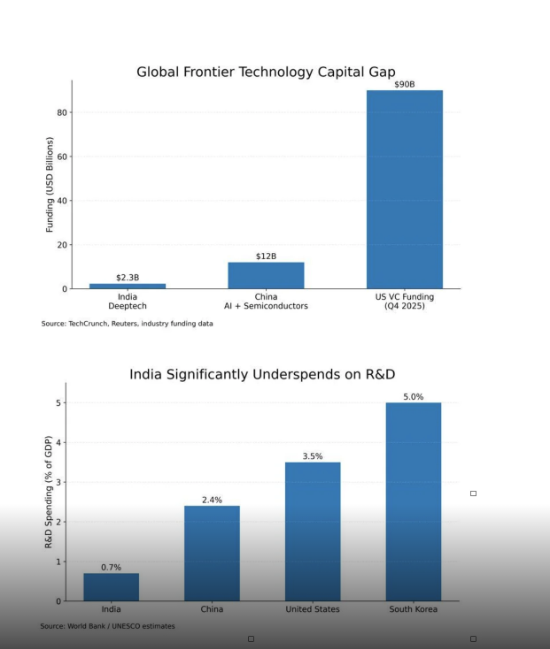
Deeptech companies are not built quarter-to–quarter. They are built decade by decade. The numbers tell the story. India’s deeptech funding ecosystem remains dramatically underdeveloped relative to its potential.
India spends only around 0.64% of GDP on research and development, compared to approximately 2.4% in China and 3.5% in the United States.[1] In 2024, Indian deeptech startups received approximately US$ 1.6 billion in funding, while China’s venture deal value in just artificial intelligence and semiconductors exceeded US$ 12 billion.[2] India’s deeptech funding increased to roughly US$ 2.3 billion in 2025, though most of that capital remained concentrated around artificial intelligence software rather than broader industrial transformation.[3] Meanwhile, the United States deployed nearly US$ 90 billion in venture funding in Q4 2025 alone.[4] The difference isn’t just about money. It’s about the mindset.
India cannot simply copy Silicon Valley
One of the biggest strategic mistakes India could make is trying to replicate Silicon Valley exactly as it exists today. India’s opportunity is different.
The US built trillion-dollar companies around software abstraction and consumer internet platforms. India’s next great opportunity may come from solving large-scale physical world problems in infrastructure that affect hundreds of millions of people.
That means – water purification; waste management; sanitation infrastructure; urban mobility; construction technology; industrial automation; grid resilience; and, supply chain modernization. These aren’t niche markets, they are civilization-scale opportunities.
For instance, India may require nearly US$ 150 billion in urban water infrastructure investment over the next 15 years, according to the World Bank.[5] Across many Indian cities, ongoing crises involving contaminated drinking water, sewage leakage, sanitation breakdowns, and unreliable infrastructure continue to affect millions.[6]
As the government and private sector companies invest billions in infrastructure, it would be a missed opportunity to not in-parallel invest in the digital technologies that can design and operate these with efficiencies embedded. Building projects the same way as they have been built for decades cannot be a long term approach. Startups can have an increased role to play here. Yet much of the venture conversation still remains disproportionately focused on short-cycle consumer applications.
I believe India’s next generation of iconic companies will emerge from entrepreneurs building technologies specifically tailored to India’s infrastructure realities and operational challenges and not from simply copying Silicon Valley.
India needs investors who operate like builders — not negotiators
One of the biggest differences I see between mature venture ecosystems and emerging ones is how investors behave during the earliest stages of company formation. In many mature ecosystems, the best early-stage investors understand that their role is not just to deploy capital. Their role is to help shape companies.
That means helping founders recruit talent, guiding product strategy, opening global networks, teaching fundraising mechanics, helping navigate manufacturing, supporting go-to-market, and preparing founders emotionally for the volatility of company building. Many Indian founders today are first-time entrepreneurs building in sectors where there are very few precedents. What they need is not aggressive equity extraction.
India’s venture ecosystem is still relatively young compared to the United States. A significant amount of capital still originates from family offices and operating company balance sheets rather than deeply institutionalized venture funds with decades of startup pattern recognition. That maturity gap matters.
India’s startup ecosystem still suffers from a trust deficit between founders and investors. In the US, early-stage conviction can translate into funding within weeks. In India, founders are often pulled into months-long diligence processes and hundreds of pages of documentation before they can unlock early stage funding. The result is slower execution, time away from building for the founders, and rising mistrust on both sides.
The most valuable investors will never be the ones who extract the most equity or lowest valuation: they will be the ones focused intently on helping maximize how far and fast the founders can build and scale globally.
Why I remain extremely bullish on India
Despite all these challenges, I remain deeply optimistic about India. I believe India could produce some of the world’s most important deeptech companies over the next decade. Indian deeptech startups are attracting increasing global attention, particularly in areas like artificial intelligence, space technology, robotics, and industrial systems.[7]
The rise of companies like Skyroot Aerospace demonstrates that India can build globally competitive frontier technology companies when capital and ambition align.[8] Institutions like IIT Madras are now building direct bridges into Silicon Valley to help founders access global venture ecosystems and commercialization opportunities.[9] This is exactly the kind of cross-border ecosystem building India needs more of.
The next decade will reward courage
The biggest venture returns rarely come from backing what already looks obvious. They come from identifying structural shifts before consensus forms. The investors who win in India over the next decade will likely be the ones willing to think independently and support founders long before markets fully understand them.
India already has most of the recipe required to build world-class deeptech companies. The question now is whether its capital markets are ready to believe in them early enough. India’s deeptech future will not be built by imported conviction. It will be built when Indian capital begins believing in Indian founders early enough, boldly enough, and patiently enough to help create globally important companies from within its own borders.
Sources
[1] Rest of World — “Why India Fell Behind China in Tech Innovation” https://restofworld.org/2025/india-falls-behind-china-deep-tech-innovation/
[2] Business Standard — “Why Indian Startups Are Stuck in Delivery While China Races Ahead” https://www.business-standard.com/companies/start-ups/india-startups-vs-china-deep-tech-innovation-ai-evs-piyush-goyal-125040400979_1.html
[3] LetsDataScience — “India Deeptech Funding Surges To $2.3 Billion” https://letsdatascience.com/news/india-deeptech-funding-surges-to-23-billion-fe16c66a
[4] TechCrunch — “India Startup Funding Hits $11B in 2025 as Investors Grow More Selective” https://techcrunch.com/2025/12/27/india-startup-funding-hits-11b-in-2025-as-investors-grow-more-selective/
[5] World Bank — “Water: Driving Jobs and Prosperity — India” https://www.worldbank.org/en/country/india/brief/how-india-is-addressing-its-water-needs
[6] The Times of India — “Illegal Connections, Pump Misuse Trigger Water Crisis in Gittikhadan” https://timesofindia.indiatimes.com/city/nagpur/illegal-connections-pump-misuse-trigger-water-crisis-in-gittikhadan/articleshow/130811037.cms
[7] Yahoo Finance — “India Has Changed Its Startup Rules for Deep Tech” https://finance.yahoo.com/news/india-changed-startup-rules-deep-033000072.html
[8] Reuters — “India’s Skyroot Becomes First $1 Billion Space-Tech Startup” https://www.reuters.com/science/indias-skyroot-becomes-first-1-bln-space-tech-startup-with-gic-sherpalo-2026-05-07/
[9] IIT Madras / The Times of India — “IIT-M Opens Silicon Valley Hub to Tap Venture Funding” https://timesofindia.indiatimes.com/city/chennai/iit-m-opens-7-5mn-silicon-valley-hub-to-tap-market-venture-funding/articleshow/